
One trip around the bases clinched it. His was a 360-foot journey exhibiting a flair and daring reminiscent of games played in backyards and sandlots. In those settings, it’s not unusual for the hero to step to the plate in the bottom of the ninth, game on the line.
Last October, in a more formal ballpark, it was only the bottom of the second. But in a scoreless Game 5 of the ALDS, only exits the vernacular.
Enter: The 2025 WTP Player of the Year.
If we relied upon the player’s foot speed to deliver news that he had received this honor, then this story is arriving right on time. And if the arrival caught you off guard even just a little, well, that’s the way Josh Naylor plays the game.
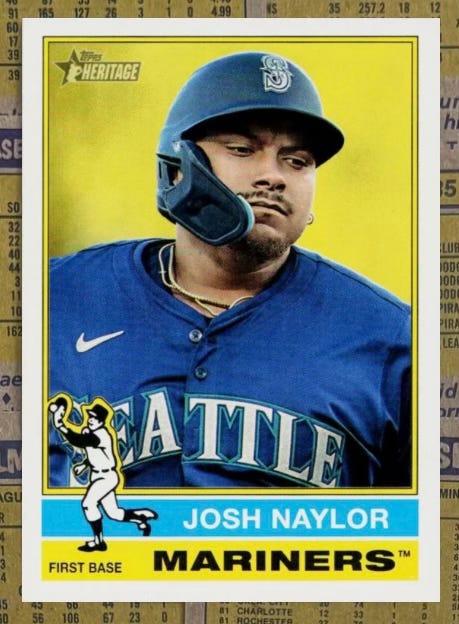
Want to get our attention? Dig in against the best pitcher in the league under the bright lights of October.
And so there stood Naylor and Tarik Skubal.
I watched this at-bat and the subsequent stolen base so many times over the winter. It’s a reminder of the power of instincts and freedom.
The reigning AL Cy Young Award winner, who had his title renewed by voters about one month later, attacked Naylor away.
Away, away, away, away, away.
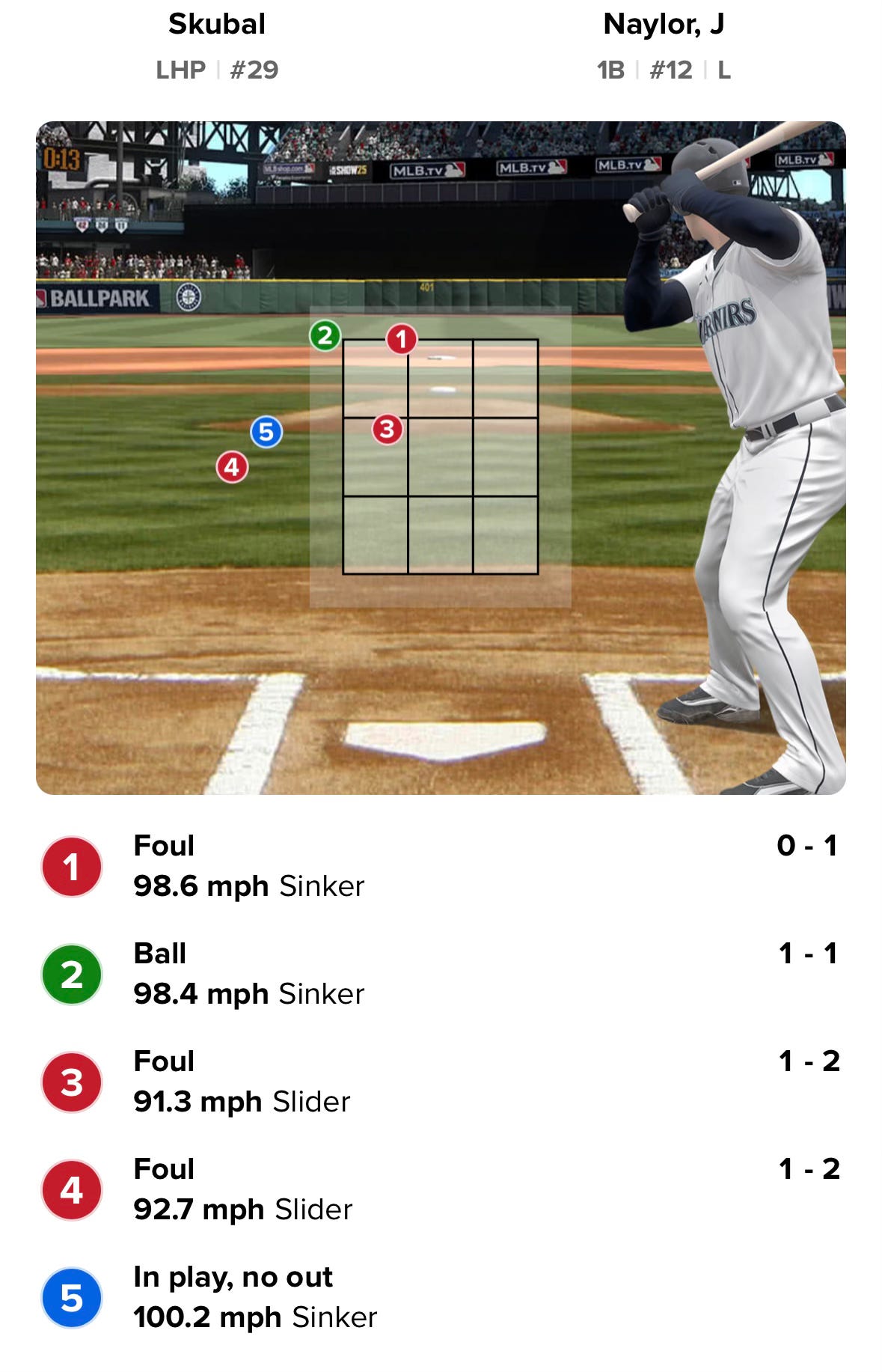
Every pitch of the at-bat was on the outer-third of the plate and beyond.
Three of the five pitches, including the 100 MPH sinker that Naylor volleyed for a double, are outside the strike zone. The thumbnail below shows the moment right around contact. Notice how Naylor’s head is down — eye on the ball! (The video is embedded immediately below, but if you prefer to click a link, here it is.)
Batted ball data tells us Naylor created an exit velocity of 89.4 MPH, and the ball traveled 283 feet in the air. Or was it Skubal who created the velocity while Naylor simply arranged the exit?
On the deciding pitch, Naylor eliminates any unnecessary movement. As he gets his front foot down, his head remains incredibly still. He is balanced. He’s in a position to be successful. His swing is so controlled that even his lower half checks itself.
Seeking additional insight about the double, I asked longtime hitting coach Turner Ward for his thoughts.
“I would love to know if there’s a drill he does,” Ward says. “A stop drill.” Ward is referring to a drill, most commonly practiced off a tee, in which the batter “puts all hits energy into the ball but stops at impact.” It’s frequently used to hone mechanics and expose flaws. For Naylor, it became a two-strike approach. Wisely so.
During the regular season, opposing batters in a 1-2 count against Skubal hit .130 with 88 strikeouts in 169 plate appearances. He only allowed five doubles to lefties all year.
The pitcher made a good pitch. Skubal had had success against Naylor earlier in the series working him away. Against any other hitter, it could have been strike three. Or maybe it’s just a ball, taken outside. But taking a 1-2 pitch against Tarik Skubal is easier done from the comfort of our living rooms. Once we suggest Naylor should just lay off it, we as observers demonstrate we’ve lost touch not just with the men in the arena but with the arena itself.
Ward, who served as Major League hitting coach for the D-backs, Dodgers, Cardinals, and Reds (in an assistant capacity), thought about something he regularly said in hitters’ meetings: “Making contact matters.”
Skubal fanned almost one out of every three batters he faced last season. He struck out 13 of the 20 Mariners he faced on October 10 in Safeco.1
“When you’re facing the best of the best, sometimes you gotta do things you wouldn’t ordinarily do, like get into your two-strike approach immediately,” Ward says. This philosophy may sound defensive, but Ward stresses that it allows the hitter to gain an advantage.
“It’s a great example of where making contact matters. He gets rewarded for using the pitcher’s power and getting his barrel to the ball, and he’s able to make something happen.”
Contact was only the beginning of Naylor making something happen.
It would be romantic to write that as he took his lead off second base — fresh off that one-out double against the Tigers’ ace — Naylor saw something that made him believe he could swipe third. After all, he was 8-for-8 in his attempts to take third base during the regular season. But this is the same player who, six days later, made the third out at third base after foolishly attempting to run on Blue Jays right fielder Addison Barger, ending a sixth-inning rally in an eventual loss in Toronto.
What we know is that Naylor is not discouraged by what others might consider limitations. His relative sprint speed in the 2025 season was in the third percentile; for every 100 Major Leaguers, 97 were faster than him. (Nevertheless, he stole 30 bases in 2025 and was caught only twice. With the Mariners, he was a perfect 19-for-19.)
In a postseason that included, by my count, players failing catastrophically to execute fundamentals three different times,2 Naylor skipped off of second base unworried, like a kid who’s been told that the most important thing is having fun.
On the 1-1 pitch to designated hitter Mitch Garver, Naylor took his lead and never stopped. Skubal’s focus was on the plate. Just like on the 1-0 pitch, he never checked the runner. Further complicating matters, the crowd noise in T-Mobile Park may have drowned out any hopes of the pitcher hearing an alert from a teammate.
Second baseman Gleyber Torres, already shifted as far up the middle as the rules allow, closed in on the base as Naylor hopped further from safety. Had Skubal peeked, we very likely would have had nobody on and two outs. Who knows how the game might have then unfolded?

Part of the thrill of watching Naylor is the fine line he walks between bases. It was even more exciting in a postseason that illuminated the blurry line between brilliance and carelessness.
Fallibility.
Twice in the ALCS against the Blue Jays, Naylor made poor decisions on the bases: once, as previously mentioned, not only testing Barger’s arm but forsaking a cardinal rule of the game; another time while jumping wildly at and making contact with the relay throw on a double play ball, resulting in an interference call (Rule 6.01(a)(5)). The latter play inspired opposing pitcher Shane Bieber to colorfully ask Naylor what he was doing, speaking on behalf of many viewers as well.
It begs the question: Was Naylor’s decision to skip away from safety towards third base against the Tigers also a horrible decision? He was only a turn of the head away from being erased. But let’s give him the benefit of the doubt — he reached 30 stolen bases by going 8-for-8 in attempts of third. I don’t want to deny his preparation nor his instincts.
Still, there’s a dark side to his daring.
In a society that demands perfection from its public figures and in a sport that’s turned hypercautious3 through big data and precise measurements, Naylor is beauty. The beauty not only of baseball but of sport, humanity, and authenticity. His measured recklessness on the base paths is the antidote to the five-inning starter; his dirty uniform, a reminder of the passion and hustle that still eludes algorithms.
Acquired in July from the D-backs, Naylor’s impact on the Mariners was enough to warrant a $92.5 million, five-year contract this past November to keep him in Seattle. Teammates laud his baseball intelligence and savvy.
Is he a throwback? Does he play the game the right way even while making the third out at third base?
Naylor was one of only 14 players last season hit at least 20 homers while stealing at least 30 bases. Consider, though, that he had entered the season with 25 career stolen bases. He was coming off his first All-Star season during which he hit 31 home runs and drove in 108 for Cleveland.
The Guardians, almost always looking to trade a player before he reaches free agency, sent Naylor to Arizona last offseason in exchange for young pitcher Slade Cecconi. (Cecconi made 23 starts for Cleveland last season and won’t reach free agency until after the 2030 season.)
He was a first-round pick (12th overall) by the Marlins in 2015 out of St. Joan of Arc Catholic Secondary School in Mississauga, Ontario. (Is the hockey game on in the Mariners’ clubhouse?)
One season into his pro career, he was traded to the Padres in a deadline deal when — brace yourselves — the Marlins were making a postseason push and San Diego was playing for next year. Naylor made his big-league debut with the Padres in 2019 before being sent to Cleveland at the 2020 trade deadline, when the Friars received pitcher Mike Clevinger to fortify their playoff rotation.
Naylor came into his own with the Guardians, posting career highs in 2023 with a .308 / .354 / .489 slash line. In Arizona he was solid, but in Seattle he transcended.
Is he late? No way. Josh Naylor is right on time.
The five batters ahead of Naylor in the lineup struck out 14 times in Game 5. Naylor was the only Mariners starter not to K even once — a remarkable wrinkle in the box score.
Nick Castellanos’ poor baserunning that allowed the Dodgers to nail him at third on a bunt; Orion Kerkering’s muff of a comebacker that ended the Philles/Dodgers NLDS; Isiah Kiner-Falefa’s ultraconservative lead off third base in the bottom of the ninth of Game 7 of the World Series. I may write more about these later during Spring Training. For now, I’ll just say that I hope all instructors and players are focusing on these fundamentals while they have the time.
Overexposed, commercialized.