
The contact was harmless. It was the kind you might see after a nasty two-seamer saws off a bat and leaves the hitter with only the handle in hand. The ball floated gently, an airborne lob not firm enough to clear the defense on the right side of the infield.
This was 10u softball, though — 10u rec league fall ball — where all contact should be celebrated.
We could call it a humpback line drive, we could call it a 70-foot flyball. In the box score, we called it an out.
Prior to that at-bat, there was nobody out and a runner on first. That runner, my daughter, had reached via base on balls.
At this age level, the rules of the game clash with the collective ability of the players. The result is a merry-go-round of stolen bases, frequent advancing on wild pitches, and haphazard base running urged by animated adults.
My daughter took off towards second just after the pitcher released the ball. The first base coach said go, so she went. (We will discuss this a lot more in a future story. As Doc Brown tells Marty McFly at the end of Back To The Future: “But your kids… something’s gotta be done about your kids.”)
The baserunner approached second as the first baseman, who had caught the batted ball, stepped on her base, completing the double play. I summoned my daughter off the field. She returned to the dugout, and I could sense what was coming. I saw her eyes filling with tears. We quickly found relative solitude behind the dugout.
“The game doesn’t make sense anymore,” she said as the tears rolled down her cheeks. She was right. Dropped third strikes, getting doubled off — the new things a child can encounter in three innings can be overwhelming.
The feelings were probably similar in the Detroit Tigers clubhouse last week. Safe to say it still doesn’t make sense at Citi Field.
As the regular season was winding down over the weekend, I checked in on the playoff-bound Padres who were hosting the Diamondbacks, mathematically alive but not well.
The D-backs had mounted an unexpected rally late in the season, long after middle-of-the-order producers Eugenio Suarez and Josh Naylor had been traded to the Mariners, long after starting pitcher Merrill Kelly was shipped to Texas.
Despite a roster ravaged by the trade deadline, Arizona arrived in San Diego with a chance to extend their season.
It started well enough. Before Padres starter Yu Darvish had a chance to settle in, Ketel Marte found a 93 MPH first-pitch fastball to his liking. At the knees and on the inside part of the plate, Marte unleashed a 410-foot rocket into the right field bleachers.
With an early lead and de facto staff ace Zac Gallen on the mound, there was reason to believe in the visiting dugout.
Fernando Tatis Jr., struck out to lead off the bottom of the first before Luis Arraez lined a double into right field.
One of my favorite luxuries brought upon by new technology in baseball is the collection of batted-ball data that reveals hit probabilities based on exit velocity and launch angle. With Arraez on second, Manny Machado scalded a ball into center field. It’s one of those plays that unfolds magically from a vantage point high above the field. The quality of contact was immediately apparent at the crack of the bat. The ball screamed into straight-away center field. Alek Thomas froze, exactly as center fielders are taught to do on a line drive. From the second deck at Petco Park, Thomas’ patience felt cavalier. Why was he waiting to retreat? Did he not know this ball is heading over his head?
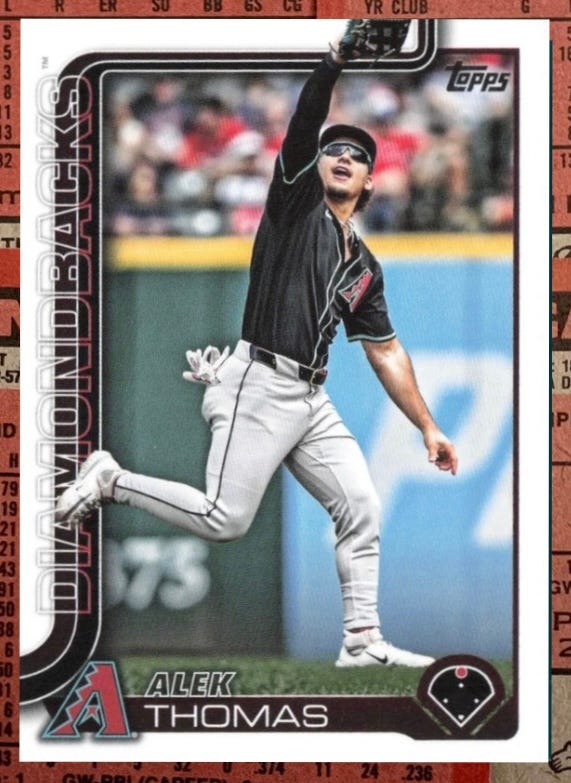
“Relax,” Thomas replied defensively. He quickly reached full speed as he charged back on the ball. Thomas hauled it in. As many hitters have shown us over 22 seasons of solid contact, dead center at Petco Park plays like a modern-day Polo Grounds.
Machado’s effort came off the bat at 110 MPH and at an angle of 20 degrees. Entering play on Friday, there had been 32 batted balls that fit those two qualifications with batters hitting a robust .875 with 11 home runs and 13 doubles. Machado’s at-bat represented the fifth time this season in which such contact resulted in an out.
Do you dare challenge the conditions of Petco Park’s center field at night? Perhaps you’d like to take on corruption in Chinatown while you’re at it.
If you won’t take it from me, I think I know someone who will help convince you.
On August 22, the Padres entered the ninth inning with a one-run lead over the Dodgers. Closer Robert Suarez was tasked with preserving the lead. As many good baseball stories begin these days, Shohei Ohtani stepped to the plate. On the third pitch of the at-bat, the soon-to-be-three-time reigning MVP hit a ball 108.5 MPH at 35 degrees. I queried all batted balls hit at 108 and 109 at 35 degrees. There were 10. All 10 were homers.
Ohtani’s bid was caught at the fence.
A few more balls have fit the criteria since then. The season total for such contact is 13-for-14 with 13 home runs.
How do you say “hit the weight room” in Japanese?
By contrast, 112 MPH at 24 degrees to left field by a right-handed hitter results in a grand slam. (Those two variables have yielded seven long balls all seven times this season.) Indeed, in the bottom of the fourth, Tatis connected with the bases loaded. The D-backs 2-0 lead became a 5-2 deficit. Gallen’s effective first three innings were undone. While the grand slam will dominate the highlights, the two-out walk to the nine-hitter with Tatis standing on deck got highlighted on my scorecard.
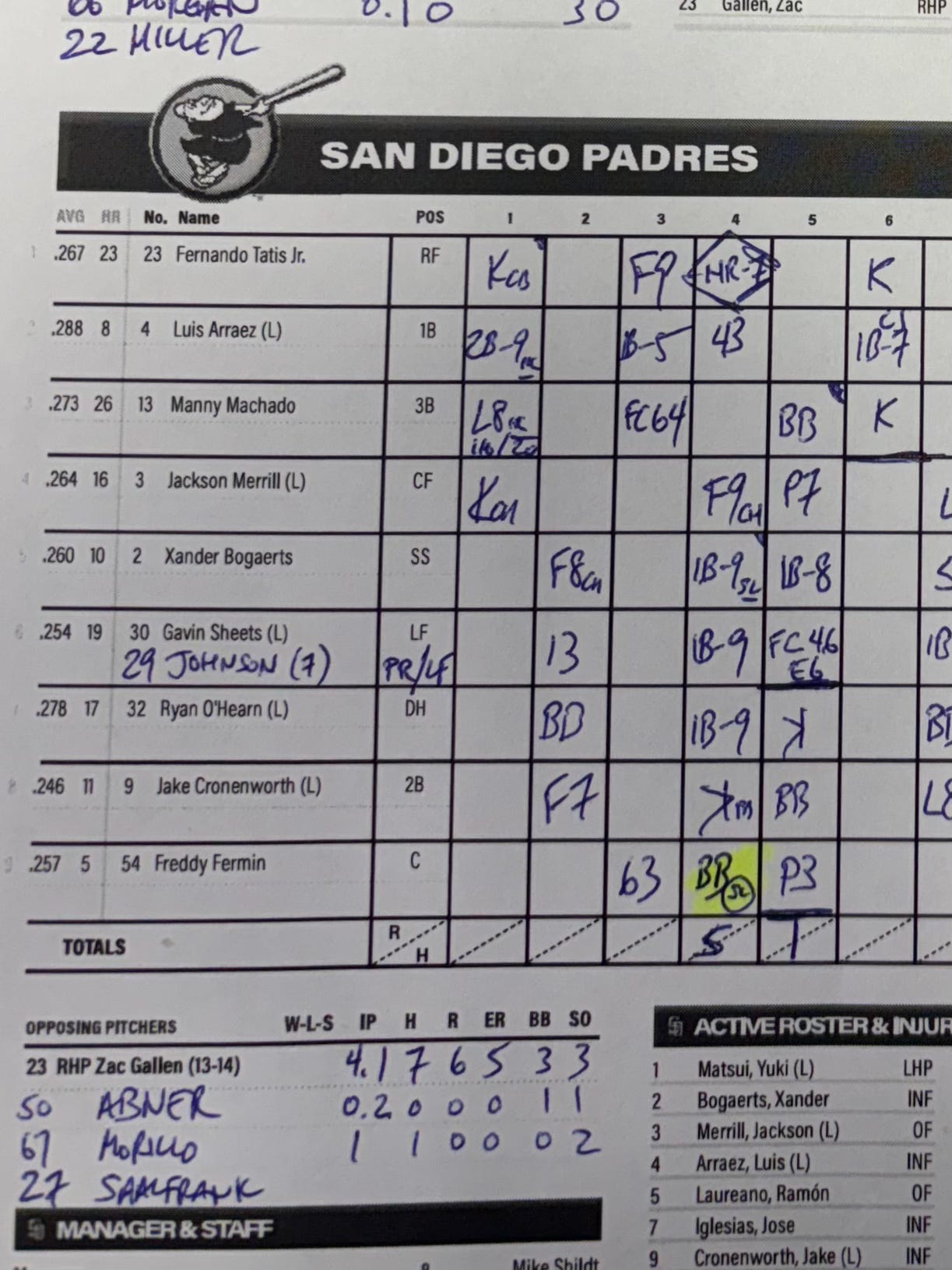
The more time I spend at Petco Park, the more I appreciate the athleticism of Tatis. On a field of elite athletes, El Niño dwarfs them all.
Back in the field after his game-changing clout, a well-struck drive by D-backs first baseman Ildemaro Vargas sent Tatis retreating. The right fielder ran back, leaped, and came up empty. Yet in a continued motion, he barehanded the ball as it bounced off the wall and quickly fired into second. In real time, it was a great effort that made a sure double slightly less certain. Vargas slid in safely, but Xander Bogaerts honored his teammate’s effort and completed the play, applying the tag to the Vargas’ left hip. The baserunner popped up from his slide, and hung above the base — not a single spike in contact with the pillow. An easy double in any other decade was immediately reviewed and overturned. Vargas vacated his position atop second base before the video review was even finalized. I wondered if he thought the game still made sense.
Today’s Starting Pitchers Tell A Story
It’s notable that, in the four Wild Card games today, three of the starting pitchers were drafted and developed by their teams. Would you be surprised if I told you that those homegrown starters are taking the ball for Cleveland, Detroit, and Cincinnati — the three teams with the lowest payrolls of the Wild Card participants?
The Red Sox acquired their starter Garrett Crochet via trade (with a significant prospect haul). The Yankees, Cubs, Padres, and Dodgers all signed their starters in free agency.
Boy, that comment by your daughter said a lot. About the game, about life. Thanks for the inside look on both.