
Only 14 rookies in the history of the game have at least hit 30 homers and driven in 100 runs or more. Since the Rookie of the Year Award was established in 1947, every eligible first-year player to have reached those power thresholds has taken home the hardware — just check the mantles of the seven most recent: Canseco, McGwire, Pizza, Pujols, (Jose) Abreu, Judge, Alonso.
Later today, we’ll learn if Sal Stewart joins them. The only thing standing in his way… is WAR.
WAR and Wetherholt, that is. For much of the season, the NL Rookie of the Year race was an NL Central affair. Stewart delivered the production expected from a big league first baseman, while the defensive work of Cardinals second baseman JJ Wetherholt earned him Gold Glove finalist honors. By midsummer, the metrics were making a lot of noise.
In late July, Wetherholt was a huge favorite — at least according to certain MLB sponsors — to win NL Rookie of the Year. I had a hard time making sense of it. Wetherholt, the seventh overall pick in the 2024 Draft, enjoyed a great April (.256 / .378 / .479) but quickly fell off. His baserunning and defense, however, cemented a reputation: The rookie was a ballplayer. The metrics proved it, and dressing him up in a Cardinals uniform only made it look better.
For fans, writers, and voters who rely on WAR, Wetherholt’s one-stop metric places him among the top-20 players in the game, alongside Jackson Chourio and Seiya Suzuki.1
Meanwhile, Stewart’s WAR drops him among the Pirates’ Nick Gonzalez and the 2026 vintage of Cal Raleigh. I guess we shouldn’t have been surprised that the official gambling sponsors of a league that is constantly promoting in-game probabilities and parlays would have fallen for a WAR darling. As the summer wore on, I started wondering if anyone was really watching Wetherholt play. Did anyone see how he went first to third on a base hit? Was anyone paying attention to his footwork around the bag? Were we appreciating the player or merely touting Outs Above Average (OAA)? Now that certain intangibles had become mathematically tangible, what did we wish to observe on the field?
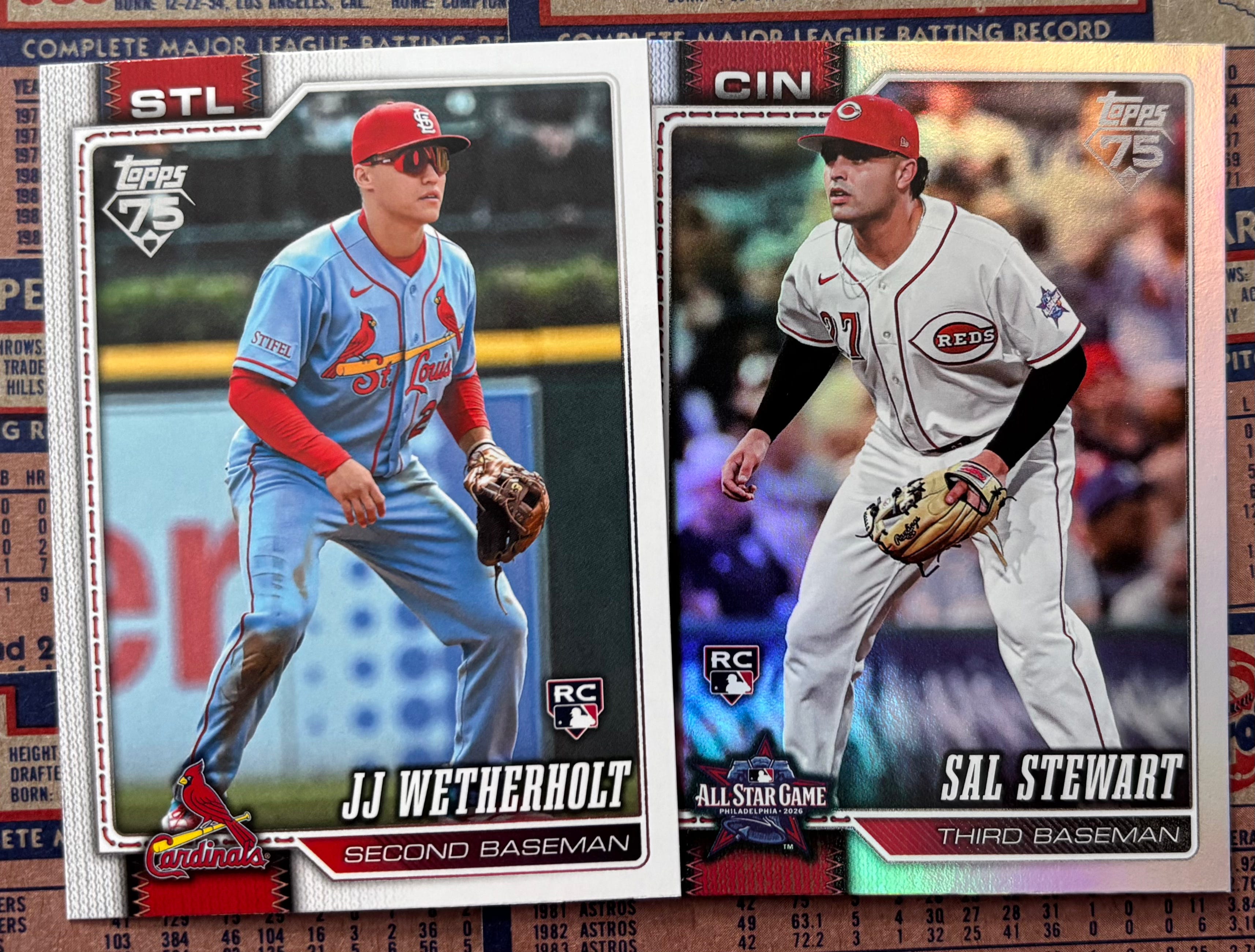
For me, the NL Rookie of the Year outcome isn’t solely about the single-season accomplishments of two players; it’s a referendum on how we watch the game and if we watch the game. Wetherholt is a great young player. His value should be appreciated as a body of work that transcends advanced metrics. At the same time, I don’t want to see Stewart’s 32 home runs and 112 RBIs penalized because of lackluster defense at first — the man puts runs on the board and produced offensively like few others ever have.
Here’s a quick aside: Who won the Gold Glove Award at first base in the American League in 2025?
He was traded at the deadline from the Twins to the Blue Jays and became a free agent following the season. His free agency carried through Thanksgiving, Christmas, New Year’s, and the Super Bowl. With all apologies to his wife, he still was alone on Valentine’s Day.
Finally, on February 16, reigning Gold Glove-winner Ty France signed a minor-league deal with the Padres. And that’s how the industry values defense at first base! (Yes, I feel like Sal Stewart should be handed the Jackie Robinson Award right now.)
In August, outstanding baseball writer Sam Miller wrote that Wetherholt’s erstwhile 14 times hit by a pitch contributed about half a point to his WAR. Make of that what you will, but counting tenths of a point as they accumulate in a spreadsheet isn’t baseball. I don’t care how much pine tar is on your calculator.
It was about 20 years ago when OPS became a mainstream statistic. Stewart posted a .787 this season; Wetherholt checked in at .704.
Whether it’s WAR or OPS, my hope is that we don’t lose sight of the game on the field. The Brewers just reminded us that so much of the game lands outside the calculations and falls between the columns.
Soon we’ll learn who’s been watching.
According to Fangraphs’ calculations.
You can’t go wrong with any of them, but if I had a vote, I’d probably cast it for Carson Benge who I think fits nicely in the middle of the Venn diagram between the Stewart and Weatherholt arguments. He posted 4.3 fWAR (just behind Weatherholt) in a well-rounded fashion that includes an overall offensive contribution very close to Stewart’s. And while he doesn’t have the novelty of a 30/100 season, he became just the 18th rookie to have at least 20 homers and 20 steals in the same year.
Why is there no mention of Carson Benge in this article when there are three finalists and he tops both Stewart and Wetherholt in WAR, average, OBP, and stolen bases, with a dead-even OPS+ to Stewart alongside vastly more defensive value? Also the first NL rookie to ever tally 20 homers, 20 steals, and 50 walks. You need to look at the full picture to make this argument, which you didn’t do.