
Baseball may not have a clock, but it keeps a calendar.
Nick Pivetta set out last Tuesday to end the Padres’ four-game losing streak. In the midst of a two-week stretch against division rivals, San Diego had already swept and been swept. It was Pivetta’s career in microcosm.
But after eight seasons of uneven performance, the right-hander has thrown together a career year in San Diego at the age of 32. He’s averaging fewer than one baserunner per inning, and his ERA and related pitching stats — no matter your preferred metrics — are among the best in the game.
He faced Rafael Devers in the top of the first inning, a matchup that offered a portal into the summer of 2015. As I wrote about after the Giants acquired him in June, I scouted Devers while he was on the Greenville Drive in the Red Sox system. Pivetta, on the other hand, proved elusive.
My coverage that year included the Harrisburg Senators and Reading Phillies. During the 2015 season, Pivetta pitched for both clubs. After starting the season with Potomac in High-A, he was promoted to the Nationals’ Double-A city in early July. A few weeks later, Pivetta, a decent prospect at the time, was sent to the Phillies in exchange for closer Jonathan Papelbon.
Ten years later, I was finally seeing him pitch in person.
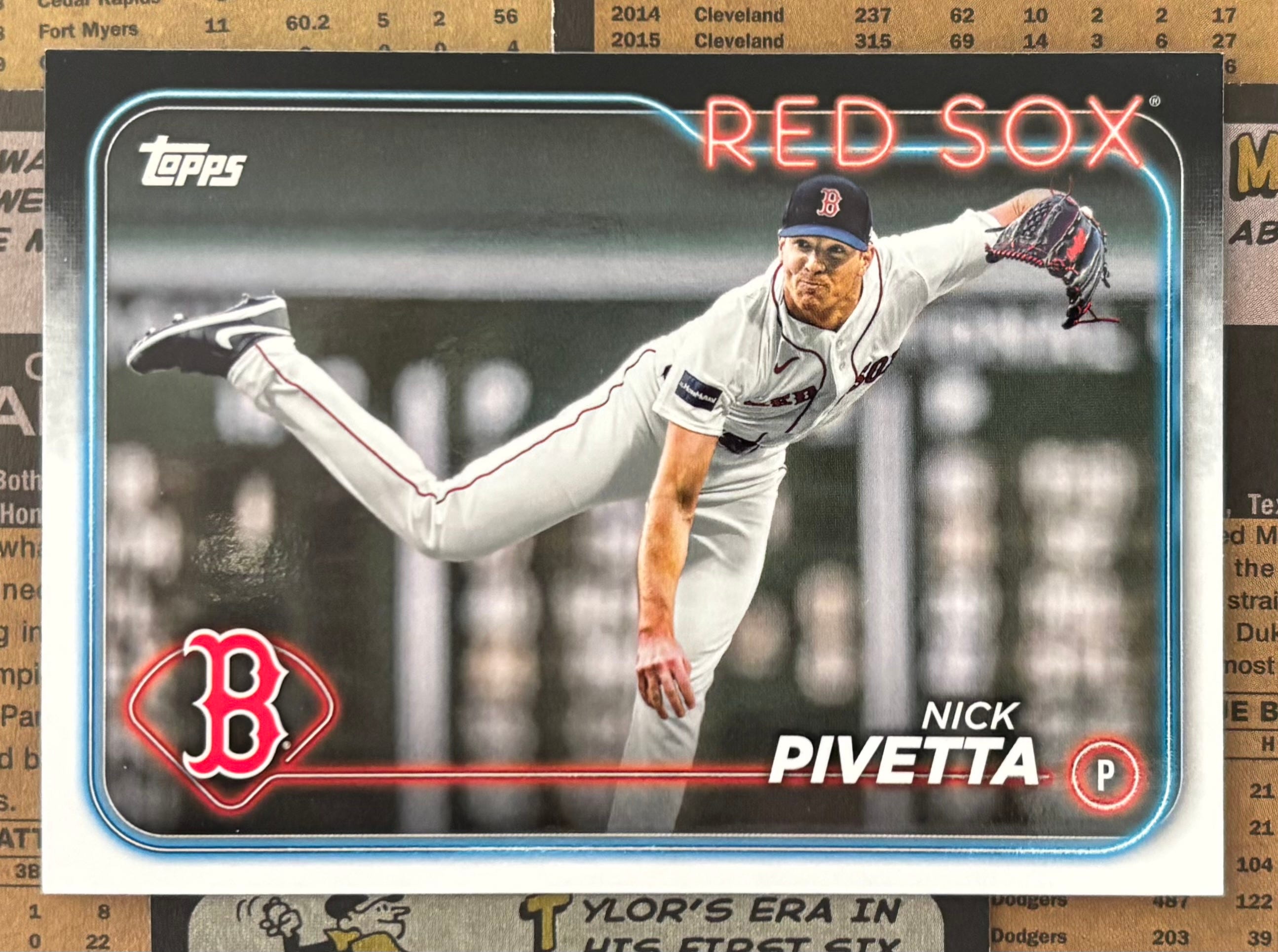
In the series opener against the Giants the night before, Padres starter Nestor Cortes was ambushed as Heliot Ramos and Devers launched back-to-back homers to start the game. On this night, Pivetta gave up a leadoff blast to right field off the bat of Jung Hoo Lee. Turned out to be all the offense the Giants would muster.
My favorite part about visiting the press level and media dining room prior to a game is the table where scouts gather to eat. Not too long ago, it took multiple tables to accommodate the group. In big league parks these days, though, you rarely need more than a four-top. The Petco Park press dining area is decorated with televisions broadcasting live games and with pictures and murals commemorating the past.
When dinner is served, a veteran evaluator is usually holding court at the informal scout table. For a group that loves to talk baseball, there’s something about the pre-game meal that taps into a deeper connection to the game. Stories tend to reflect a more innocent love of the game — more mural than live broadcast. Whereas postgame gatherings often involve a few beers and analysis of that day’s events, dinner is storytime. Conversation around the table is a history lesson, an ephemeral documentary that streams only once, just for the gathered audience.
I find two scouts I worked with at various times in my career. Once upon a time, talking baseball and life with these guys was a perk of my job. Today, I appreciate it differently. It’s great to see them both.
In the bottom of the first, Luis Arraez drilled a trackable 0-2 slider into right field for a double. It was a sure two-bagger off the bat with Giants right fielder Drew Gilbert shading the left-handed hitter a bit the other way. The only question was whether Fernando Tatis Jr., who had reached on an error, would try to score.
With nobody out and Manny Machado due up, there was no reason to force the issue. Padres third base coach Tim Leiper knew it, and he held up his lead runner. Tatis obliged.
The decisive moment while approaching third isn’t about the base coach; it’s about the aggression with which Tatis runs. He wanted to score. He committed on contact to give himself a chance to be waved home. From my higher vantage point within the stadium, base running can be better appreciated. Can I call balls and strikes from the press box? No. But outfielders’ jumps and routes, infielders’ pre-pitch movements, and baserunners’ effort levels reveal themselves without inhibition.
Tatis went first to third with incredible power and energy. It was almost violent when he slammed on the breaks after recognizing Leiper’s stop sign. There was minimal deceleration before achieving a complete stop, yet he was under complete control. Athleticism shows up in different ways.
Machado brings his teammate home on a slow roller to third base. Arraez is stranded after strikeouts from Ryan O’Hearn and Xander Bogaerts. The game is tied at one after 1.
I take the empty seat at the table. I’m next to a scout I worked closely with in Arizona. There are three other men at the table: one is a scout I know well, one is recognize and introduce myself to, and the final gentleman — immediately to my left — silently lets me know he’s not part of the scouting corps. He’s wearing shorts and a Giants hat, and he’s slightly turned away from me such that I don’t see his full profile. He’s part of another conversation, and I shift my attention to my friend and former colleague to the right.
With the bases loaded and two outs in the bottom of the fourth, Tatis takes his lead off of first. He arrived via a four-pitch run-scoring walk. The Padres have scored twice so far this inning, claiming a 3-1 lead.
Arraez can set Tatis free with a gapper. It would be the hit to break the game open and allow Tatis to score from first. Alas, Arraez hits a soft line drive into left field that’s easily corralled by Ramos. Tatis never got underway. The Padres lead, 3-1, after four innings.
A called strike three on a fastball down the middle gets shortstop Christian Koss looking and ends the Giants half of the sixth. It will also mark the end of Pivetta’s night after 109 pitches. His final line is the reward for an outing that required winning pivotal at-bats and making pitches when he had to. Pivetta faced 24 batters, allowing only three hits, walking two, hitting one, and striking out 10. The lone blemish was delivered by leadoff hitter Lee, whose 400-foot drive to right gave the Giants a fleeting advantage.
Two conversations unfold simultaneously at the table. My friend quiets as he reaches a natural end to his story. The other person — in shorts and a hat — becomes the only voice at the table. It’s as if a studio engineer behind the soundboard turned down all the other instruments. Only isolated vocals remain. They’re instantly recognizable.
Let’s do a little math. Pivetta pitched six innings, meaning 18 of the 24 batters he faced did not lead off an inning. Of those 18 Giants hitters, he only faced five of them with nobody on base. That’s a stressful night at the office.
I saw a pitcher who challenged hitters with his fastball and wasn’t afraid to throw strikes. His command was spotty, but his four-seamer has good plane and good ride. He won’t be seeing any lineups like this in October, but no doubt his performance tonight inspires words like “gritty” and “gutsy,” a couple of the ingredients postseason heroes are made of. I’d like to be part of the conversation at the bar after the game as scouts discuss Pivetta’s repertoire and execution.
Bottom of the sixth and — with another run in already — Machado laced a hit into right field. Tatis advanced to second. Before I can describe just how hard Machado has been hitting the ball, Tatis stole third on absent-minded reliever Carson Seymour, whose last name was proven a lie by the Padres’ ambitious baserunner.
The voice is in the middle of a story about Gaylord Perry, whose name was brought up under the category of Hall of Famers who made stops in San Diego during their careers. This is the voice that narrated Orioles games throughout my youth, the voice of evening car rides with my parents and sister during my childhood, the voice who, alongside Joe Morgan, joined my friends and me for a game every Sunday night for more than 20 years. For a moment, I laugh at myself: I’ve been sitting next to Jon Miller for 10 minutes. You know, the guy in the shorts and hat. Of course. I snap out of it; Miller is painting the picture of a doubleheader on May 31, 1964. It was game 2 of a doubleheader at Shea Stadium. Juan Marichal had gone the distance for the Giants in a game 1 victory. Perry was in his third season, and, according to Miller, the Giants were growing frustrated with him. He had yet to find his Cooperstown trajectory. His future was uncertain. Locked in a 6-6 tie, San Francisco needed relief. Perry provided it. He entered in the 13th inning and threw 10 — ten!! — scoreless innings. Del Crandall and Jesus Alou drove in runs in the top of the 23rd; Perry got the win and Bob Hendley came in for the save.

This game has gone the way we might expect it to. If these two lineups faced each other on this day 1,000 times, this outcome — a Padres victory in which the more talented team with the better starting pitcher controlled the tempo and scoreboard — should be the most frequently achieved.
As I considered that previous sentence, I began thinking about the final score — the most obvious representation of the game — versus the nine-inning journey. I wondered how those who heard the game through Jon Miller’s words experienced Giants baseball.
For most of the evening, I felt the warmth of Miller’s chronicles. In the middle innings, I fact-checked the story about Perry’s relief outing, not because I didn’t trust Miller’s memory but because I wanted to marvel at his accuracy. His is not a fountain of knowledge reserved only for airtime. It’s a passion he loves to share. It’s how, at a table with a few scouts killing time before first pitch, he led us from Perry pitching at Shea to McCovey roaming the outfield at Candlestick.
The guy in the shorts and the Giants hat.
Wow, you had me on the edge of my seat, Ryan, and what a reveal! Loved Miller calling O’s games back in the day. Great piece, as usual.